Home

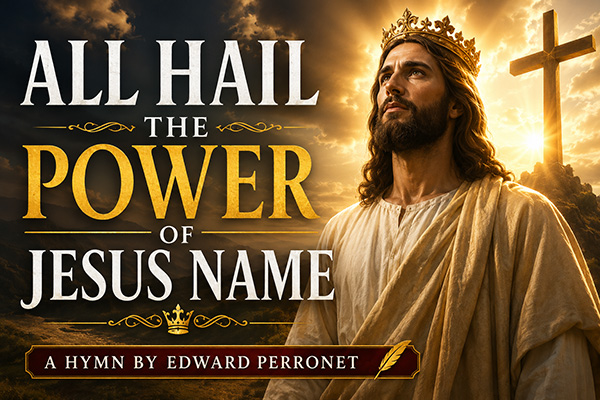
Story of All Hail the Power of Jesus' Name
Avatar


Edward Perronet

Sundridge, Kent, England

Written: 1779–1780


1726-1792

Minister in Canterbury, hymn writer


Keywords

Jesus Power King Hail


Sing All Hail the Power of Jesus' Name

Lyrics for All Hail the Power of Jesus' Name

1. All hail the power of Jesus' name! Let angels prostrate fall; Bring forth the royal diadem, And crown Him Lord of all! Bring forth the royal diadem, And crown Him Lord of all!

2. Ye chosen seed of Israel's race, Ye ransomed from the fall, Hail Him who saves you by His grace, And crown Him Lord of all! Hail Him who saves you by His grace, And crown Him Lord of all!

3. Let every kindred, every tribe On this terrestrial ball, To Him all majesty ascribe, And crown Him Lord of all! To Him all majesty ascribe, And crown Him Lord of all!

4. O that with yonder sacred throng We at His feet may fall! We'll join the everlasting song, And crown Him Lord of all! We'll join the everlasting song, And crown Him Lord of all!


Story of All Hail the Power of Jesus' Name 1779–1780

Story of the hymn All Hail the Power of Jesus' Name


Story of All Hail the Power of Jesus' Name

Story of All Hail the Power of Jesus' Name

  • "All Hail the Power of Jesus' Name" is a beloved Christian hymn sometimes called the "National Anthem of Christendom." It was written by Edward Perronet (1726–1792).
  • The text is a majestic call to worship, proclaiming Jesus' supreme Lordship and inviting all creation to crown Him "Lord of all."


Story of All Hail the Power of Jesus' Name Date: 1779–1780

All Hail the Power of Jesus' Name - Details


Listen:

Edward Perronet's Background

Perronet came from a family of French Huguenot refugees who fled religious persecution, first to Switzerland and then to England. His father, Vincent Perronet, was an Anglican vicar and a close friend of John and Charles Wesley, key leaders of the Methodist revival. Edward followed a similar path: he became an evangelical preacher and worked closely with the Wesleys for years, though he had a somewhat independent and fiery personality. He was known for strong opinions.

For example, he advocated that Methodist preachers should administer the Lord’s Supper (against John Wesley’s preferences at the time) and even published a satirical work (The Mitre) criticizing the Church of England, which caused tension with figures like the Countess of Huntingdon. He eventually served as a minister in an independent chapel in Canterbury, where he died in 1792.

One memorable anecdote illustrates his humility (or wit): When John Wesley insisted he preach to a large crowd, Perronet took the pulpit and announced he would deliver "the greatest sermon ever preached on earth," then simply read the Sermon on the Mount and sat down.

The Hymn's Origins (1779–1780)

Perronet wrote the hymn relatively late in life. It first appeared anonymously in the November 1779 issue of the Gospel Magazine (edited by Augustus Toplady, author of "Rock of Ages"). A full eight-stanza version was published in April 1780 under the title “On the Resurrection. The Lord is King.” It was later included in Perronet’s 1785 collection Occasional Verses, Moral and Sacred.

The text is a majestic call to worship, proclaiming Jesus' supreme lordship and inviting all creation, angels, Israel’s chosen race, sinners, martyrs, and every kindred and tribe, to crown Him "Lord of all." It draws on themes of resurrection and coronation (referencing imagery like the "royal diadem"). John Rippon made significant revisions in his 1787 hymn collection (including the now-familiar final stanza: "O that with yonder sacred throng / We at His feet may fall..."), which helped popularize the version most sung today.

Famous Stories and Impact

The hymn’s popularity led to many inspiring (if sometimes legendary) accounts of its power: Missionary E.P. Scott in India: One of the best-known stories tells of American missionary E.P. Scott, who ventured into hostile territory among a remote tribe. Surrounded by warriors with raised spears, he closed his eyes, played his violin, and sang “All Hail the Power of Jesus' Name,” especially the lines about "every kindred, every tribe." The warriors reportedly lowered their weapons, welcomed him, and he spent years ministering to them.

Other tales include a dying woman who repeated words from the hymn, and its use in various revivals and missionary contexts worldwide.


Watch on YouTube

All Hail the Power of Jesus' Name - Video


Sing along on YouTube:


Story of All Hail the Power of Jesus' Name

All Hail the Power of Jesus' Name - Devotional


The hymn opens with a call that feels less like an invitation and more like a proclamation. To hail the power of Jesus' name is to acknowledge that His authority is not abstract or distant. It is present, active, and world‑shaping. Scripture tells us that God has given Him the name above every name, a name before which every knee will bow. Perronet's hymn simply urges the worshiper to begin bowing now, not out of fear but out of joyful recognition that Christ is King.

As the verses unfold, the hymn gathers worshipers from every corner of redemptive history. It calls Israel's chosen seed, the ransomed, the martyrs, and finally every tribe and every nation. Worship becomes a widening circle, a global procession of people who have discovered that Jesus is worthy of a crown. The hymn refuses to let praise be a private act. It insists that worship is communal, historical, and cosmic.

Reflection:

Take a moment today to reflect: Are you celebrating the power of Jesus' name in your life? Crown Him Lord of all in everything you do today!

Prayer:

Heavenly Father, thank You for the power of Jesus' name. Help us to fall at His feet, crown Him Lord of all, and ascribe all majesty to Him!

Celebrate His Lordship today!